

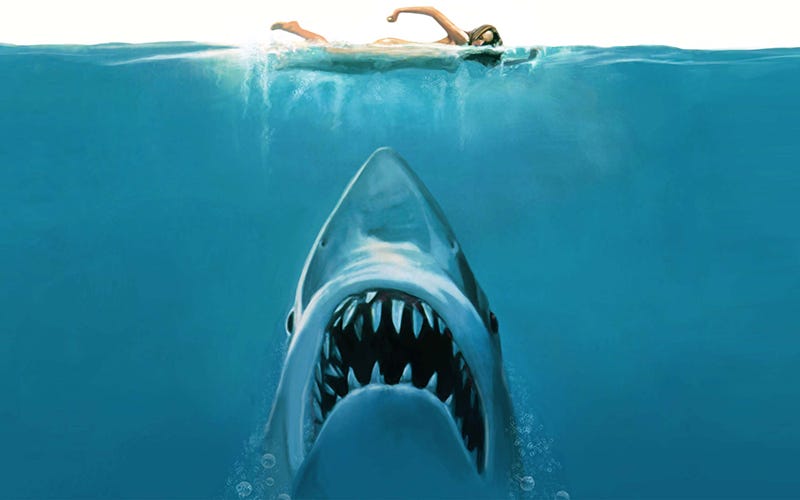
You are standing in waist-deep water, playing with your friends, splashing and laughing as the summer sun beats down. Suddenly, out of the corner of your eye, you notice a dark, shadowy shape moving beneath the surface. Your heart skips a beat as scenes from Jaws flash through your mind, along with news stories about shark attacks along the eastern seaboard. Before you can even process what you saw, you are running toward shore as fast as you can, the water dragging against your legs.
You finally reach the gritty sand and turn around to look back at the water. You scan the waves expecting to see a fin cutting through the surface. But there is nothing there. No splash. No movement. Nothing at all. You begin to question whether anything was ever there in the first place. Yet the fear you felt was real. This instinctive panic about something you cannot even confirm exists is often referred to as “shark fever.”
Sharks have long been misunderstood and misrepresented in media and culture, creating unnecessary fear toward these animals. This matters because the way sharks are portrayed influences how people think about them and whether society supports protecting them. Today I will discuss how the film Jaws helped create widespread fear of sharks, how modern media exaggerates shark attacks, and why sharks are actually essential to ocean ecosystems.
First, the cultural impact of Jaws dramatically shaped how society views sharks. The film, based on a novel by Peter Benchley, portrayed a giant great white shark that deliberately hunts people along a beach community. While this made for an exciting thriller, it also created a powerful and lasting image of sharks as monsters of the sea. According to the Smithsonian Institution Ocean Portal, the popularity of the film helped reinforce the idea that sharks are aggressive predators that target humans. After the film’s release, many people became afraid to swim in the ocean, and shark hunting tournaments increased in popularity.
The second reason sharks are misunderstood is sensationalized media coverage. Shark attacks are rare events, but when they happen they receive intense news coverage. Dramatic headlines and frightening images make these incidents seem far more common than they actually are. According to the Florida Museum of Natural History International Shark Attack File, there are typically around 70 to 80 unprovoked shark attacks worldwide each year, and fatalities usually average fewer than ten annually. Considering the millions of people who enter the ocean every year, the risk of being attacked by a shark is extremely small. However, because these incidents are shocking and unusual, they attract attention and reinforce public fear.
Finally, sharks play an essential role in maintaining healthy ocean ecosystems. Sharks are apex predators, meaning they sit at the top of the marine food chain and regulate populations of other species. The National Oceanic and Atmospheric Administration explains that apex predators like sharks help maintain balance in marine ecosystems by preventing certain species from becoming too numerous. Without sharks, this balance can be disrupted, which can harm coral reefs and other important ocean habitats. Despite their importance, sharks themselves face serious threats. Scientists estimate that humans kill around 100 million sharks every year through fishing and shark finning.
In conclusion, sharks have been widely misunderstood because of media portrayals and exaggerated coverage of rare attacks. The influence of Jaws, sensationalized news reporting, and widespread misconceptions have all contributed to the fear surrounding sharks. However, the reality is very different. Sharks rarely attack humans, and they are essential to maintaining the balance of marine ecosystems.
The next time you step into the ocean and feel that moment of fear about what might be beneath the surface, remember that the real story of sharks is not one of terror, but one of misunderstanding.
Florida Museum of Natural History. “International Shark Attack File.”
https://www.floridamuseum.ufl.edu/shark-attacks/
Smithsonian Ocean Portal. “Sharks and Their Role in the Ocean.”
https://ocean.si.edu/ocean-life/sharks-rays
National Oceanic and Atmospheric Administration (NOAA Fisheries). “Sharks and Their Importance to Marine Ecosystems.”
https://www.fisheries.noaa.gov
Benchley, Peter. Jaws. Doubleday Publishing.